 Add to Chrome
 Add to Firefox
 Add to Edge
StemBind: When MLLMs Get Lost Between Rules and Instances in Abstract Visual Reasoning
May 29, 2026
Multimodal large language models (MLLMs) often know the rule but pick the wrong answer: on abstract visual reasoning (AVR) tasks, a model can describe what it sees and name the underlying pattern, yet still fail to choose the matching candidate. Existing AVR benchmarks cannot detect this because they collapse perception, rule induction, and answer selection into a single right-or-wrong signal. We introduce StemBind, a shared-stem diagnostic benchmark that probes the same visual stem with three aligned questions: Perception (what is in the image), Rule (what pattern governs it), and Full (which option completes it), so a final-answer error can be attributed to a specific sub-step on the same evidence. StemBind contains 2,298 curated knowledge-light stems across nine auditable visual operations, totaling 19,533 P/R/F tasks, with each full item annotated by Sternberg's four reasoning stages (S1 Encode, S2 Infer, S3 Map, S4 Apply). Evaluating 24 frontier MLLM configurations yields four findings. (i) The R-F chasm: rule accuracy exceeds full-item accuracy on 22 of 24 models, so most failures happen after the rule is identified. (ii) A persistent binding gap: even when P and R are both correct on the same stem, models still answer F incorrectly 51.2% of the time. (iii) The bottleneck is S3: process diagnostics and Stage-wise Stimulus Augmentation localize the dominant failure to rule-to-instance mapping. (iv) Scaling and thinking do not help: neither larger models nor explicit thinking mode reliably closes the gap, and thinking even lowers rule and full-item accuracy. StemBind reframes AVR evaluation from final-answer ranking to locating where abstract visual reasoning breaks down, identifying rule-to-instance binding as a concrete next target for vision-grounded reasoning.

Advantage Collapse in Group Relative Policy Optimization: Diagnosis and Mitigation
May 20, 2026Group Relative Policy Optimization (GRPO), a prominent algorithm within the Reinforcement Learning from Verifiable Rewards (RLVR) framework, has achieved strong results in improving the reasoning capabilities of large language models (LLMs). However, GRPO is prone to advantage collapse, a failure mode where homogeneous rewards within a group (e.g., all correct or all incorrect answers) yield near-zero advantages and vanishing gradients. To address this, we introduce the Advantage Collapse Rate (ACR), the first diagnostic metric quantifying the proportion of training batches with ineffective gradients. Across models from 0.5B to 14B parameters on mathematical reasoning benchmarks, we show that ACR strongly predicts training stagnation and final performance. We then propose Adaptive Virtual Sample Policy Optimization (AVSPO), a lightweight extension of GRPO that injects virtual reward samples, guided by real-time ACR monitoring, to enable learning from homogeneous groups without additional model rollouts. AVSPO reduces advantage collapse by 58-63% relative to GRPO and yields consistent accuracy gains of 4-6 percentage points across all model scales, while maintaining generalization on the evaluated out-of-domain task. Code and datasets are available at https://qingyonghu.github.io/AVSPO.
When AI Meets Early Childhood Education: Large Language Models as Assessment Teammates in Chinese Preschools
Mar 25, 2026High-quality teacher-child interaction (TCI) is fundamental to early childhood development, yet traditional expert-based assessment faces a critical scalability challenge. In large systems like China's-serving 36 million children across 250,000+ kindergartens-the cost and time requirements of manual observation make continuous quality monitoring infeasible, relegating assessment to infrequent episodic audits that limit timely intervention and improvement tracking. In this paper, we investigate whether AI can serve as a scalable assessment teammate by extracting structured quality indicators and validating their alignment with human expert judgments. Our contributions include: (1) TEPE-TCI-370h (Tracing Effective Preschool Education), the first large-scale dataset of naturalistic teacher-child interactions in Chinese preschools (370 hours, 105 classrooms) with standardized ECQRS-EC and SSTEW annotations; (2) We develop Interaction2Eval, a specialized LLM-based framework addressing domain-specific challenges-child speech recognition, Mandarin homophone disambiguation, and rubric-based reasoning-achieving up to 88% agreement; (3) Deployment validation across 43 classrooms demonstrating an 18x efficiency gain in the assessment workflow, highlighting its potential for shifting from annual expert audits to monthly AI-assisted monitoring with targeted human oversight. This work not only demonstrates the technical feasibility of scalable, AI-augmented quality assessment but also lays the foundation for a new paradigm in early childhood education-one where continuous, inclusive, AI-assisted evaluation becomes the engine of systemic improvement and equitable growth.
ENC-Bench: A Benchmark for Evaluating Multimodal Large Language Models in Electronic Navigational Chart Understanding
Mar 24, 2026Electronic Navigational Charts (ENCs) are the safety-critical backbone of modern maritime navigation, yet it remains unclear whether multimodal large language models (MLLMs) can reliably interpret them. Unlike natural images or conventional charts, ENCs encode regulations, bathymetry, and route constraints via standardized vector symbols, scale-dependent rendering, and precise geometric structure -- requiring specialized maritime expertise for interpretation. We introduce ENC-Bench, the first benchmark dedicated to professional ENC understanding. ENC-Bench contains 20,490 expert-validated samples from 840 authentic National Oceanic and Atmospheric Administration (NOAA) ENCs, organized into a three-level hierarchy: Perception (symbol and feature recognition), Spatial Reasoning (coordinate localization, bearing, distance), and Maritime Decision-Making (route legality, safety assessment, emergency planning under multiple constraints). All samples are generated from raw S-57 data through a calibrated vector-to-image pipeline with automated consistency checks and expert review. We evaluate 10 state-of-the-art MLLMs such as GPT-4o, Gemini 2.5, Qwen3-VL, InternVL-3, and GLM-4.5V, under a unified zero-shot protocol. The best model achieves only 47.88% accuracy, with systematic challenges in symbolic grounding, spatial computation, multi-constraint reasoning, and robustness to lighting and scale variations. By establishing the first rigorous ENC benchmark, we open a new research frontier at the intersection of specialized symbolic reasoning and safety-critical AI, providing essential infrastructure for advancing MLLMs toward professional maritime applications.
Efficient Hallucination Detection: Adaptive Bayesian Estimation of Semantic Entropy with Guided Semantic Exploration
Mar 24, 2026Large language models (LLMs) have achieved remarkable success in various natural language processing tasks, yet they remain prone to generating factually incorrect outputs known as hallucinations. While recent approaches have shown promise for hallucination detection by repeatedly sampling from LLMs and quantifying the semantic inconsistency among the generated responses, they rely on fixed sampling budgets that fail to adapt to query complexity, resulting in computational inefficiency. We propose an Adaptive Bayesian Estimation framework for Semantic Entropy with Guided Semantic Exploration, which dynamically adjusts sampling requirements based on observed uncertainty. Our approach employs a hierarchical Bayesian framework to model the semantic distribution, enabling dynamic control of sampling iterations through variance-based thresholds that terminate generation once sufficient certainty is achieved. We also develop a perturbation-based importance sampling strategy to systematically explore the semantic space. Extensive experiments on four QA datasets demonstrate that our method achieves superior hallucination detection performance with significant efficiency gains. In low-budget scenarios, our approach requires about 50% fewer samples to achieve comparable detection performance to existing methods, while delivers an average AUROC improvement of 12.6% under the same sampling budget.
Period-LLM: Extending the Periodic Capability of Multimodal Large Language Model
May 30, 2025


Periodic or quasi-periodic phenomena reveal intrinsic characteristics in various natural processes, such as weather patterns, movement behaviors, traffic flows, and biological signals. Given that these phenomena span multiple modalities, the capabilities of Multimodal Large Language Models (MLLMs) offer promising potential to effectively capture and understand their complex nature. However, current MLLMs struggle with periodic tasks due to limitations in: 1) lack of temporal modelling and 2) conflict between short and long periods. This paper introduces Period-LLM, a multimodal large language model designed to enhance the performance of periodic tasks across various modalities, and constructs a benchmark of various difficulty for evaluating the cross-modal periodic capabilities of large models. Specially, We adopt an "Easy to Hard Generalization" paradigm, starting with relatively simple text-based tasks and progressing to more complex visual and multimodal tasks, ensuring that the model gradually builds robust periodic reasoning capabilities. Additionally, we propose a "Resisting Logical Oblivion" optimization strategy to maintain periodic reasoning abilities during semantic alignment. Extensive experiments demonstrate the superiority of the proposed Period-LLM over existing MLLMs in periodic tasks. The code is available at https://github.com/keke-nice/Period-LLM.
Sage Deer: A Super-Aligned Driving Generalist Is Your Copilot
May 15, 2025The intelligent driving cockpit, an important part of intelligent driving, needs to match different users' comfort, interaction, and safety needs. This paper aims to build a Super-Aligned and GEneralist DRiving agent, SAGE DeeR. Sage Deer achieves three highlights: (1) Super alignment: It achieves different reactions according to different people's preferences and biases. (2) Generalist: It can understand the multi-view and multi-mode inputs to reason the user's physiological indicators, facial emotions, hand movements, body movements, driving scenarios, and behavioral decisions. (3) Self-Eliciting: It can elicit implicit thought chains in the language space to further increase generalist and super-aligned abilities. Besides, we collected multiple data sets and built a large-scale benchmark. This benchmark measures the deer's perceptual decision-making ability and the super alignment's accuracy.
Lighten CARAFE: Dynamic Lightweight Upsampling with Guided Reassemble Kernels
Oct 29, 2024As a fundamental operation in modern machine vision models, feature upsampling has been widely used and investigated in the literatures. An ideal upsampling operation should be lightweight, with low computational complexity. That is, it can not only improve the overall performance but also not affect the model complexity. Content-aware Reassembly of Features (CARAFE) is a well-designed learnable operation to achieve feature upsampling. Albeit encouraging performance achieved, this method requires generating large-scale kernels, which brings a mass of extra redundant parameters, and inherently has limited scalability. To this end, we propose a lightweight upsampling operation, termed Dynamic Lightweight Upsampling (DLU) in this paper. In particular, it first constructs a small-scale source kernel space, and then samples the large-scale kernels from the kernel space by introducing learnable guidance offsets, hence avoiding introducing a large collection of trainable parameters in upsampling. Experiments on several mainstream vision tasks show that our DLU achieves comparable and even better performance to the original CARAFE, but with much lower complexity, e.g., DLU requires 91% fewer parameters and at least 63% fewer FLOPs (Floating Point Operations) than CARAFE in the case of 16x upsampling, but outperforms the CARAFE by 0.3% mAP in object detection. Code is available at https://github.com/Fu0511/Dynamic-Lightweight-Upsampling.
Divide and Conquer: Improving Multi-Camera 3D Perception with 2D Semantic-Depth Priors and Input-Dependent Queries
Aug 13, 20243D perception tasks, such as 3D object detection and Bird's-Eye-View (BEV) segmentation using multi-camera images, have drawn significant attention recently. Despite the fact that accurately estimating both semantic and 3D scene layouts are crucial for this task, existing techniques often neglect the synergistic effects of semantic and depth cues, leading to the occurrence of classification and position estimation errors. Additionally, the input-independent nature of initial queries also limits the learning capacity of Transformer-based models. To tackle these challenges, we propose an input-aware Transformer framework that leverages Semantics and Depth as priors (named SDTR). Our approach involves the use of an S-D Encoder that explicitly models semantic and depth priors, thereby disentangling the learning process of object categorization and position estimation. Moreover, we introduce a Prior-guided Query Builder that incorporates the semantic prior into the initial queries of the Transformer, resulting in more effective input-aware queries. Extensive experiments on the nuScenes and Lyft benchmarks demonstrate the state-of-the-art performance of our method in both 3D object detection and BEV segmentation tasks.
GPT as Psychologist? Preliminary Evaluations for GPT-4V on Visual Affective Computing
Mar 09, 2024


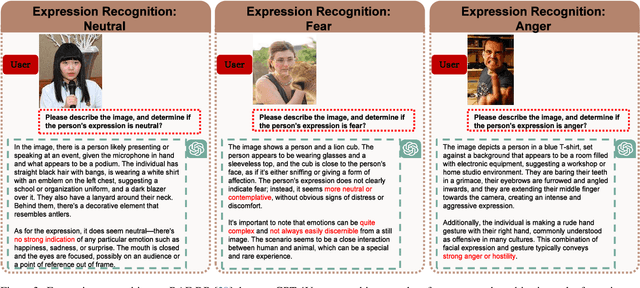
Multimodal language models (MLMs) are designed to process and integrate information from multiple sources, such as text, speech, images, and videos. Despite its success in language understanding, it is critical to evaluate the performance of downstream tasks for better human-centric applications. This paper assesses the application of MLMs with 5 crucial abilities for affective computing, spanning from visual affective tasks and reasoning tasks. The results show that GPT4 has high accuracy in facial action unit recognition and micro-expression detection while its general facial expression recognition performance is not accurate. We also highlight the challenges of achieving fine-grained micro-expression recognition and the potential for further study and demonstrate the versatility and potential of GPT4 for handling advanced tasks in emotion recognition and related fields by integrating with task-related agents for more complex tasks, such as heart rate estimation through signal processing. In conclusion, this paper provides valuable insights into the potential applications and challenges of MLMs in human-centric computing. The interesting samples are available at \url{https://github.com/LuPaoPao/GPT4Affectivity}.